A trade can be profitable on Friday afternoon and still create a problem when the market reopens on Monday. Prices may gap, spreads can widen, and overnight financing charges can reduce equity while a position remains open. For prop traders, there is another consideration: the firm’s rules may require positions to be closed before the end of the trading day or before the weekend.
These restrictions are not uniform across the industry. Some proprietary trading firms permit overnight and weekend holding across their programs. Others allow it during an evaluation but impose tighter conditions after a trader qualifies. Certain firms offer a dedicated swing account, while futures-focused programs may require every position to be closed at a specified time each day.
The difference matters when choosing a challenge. A strategy based on four-hour charts, daily support and resistance, or multi-day trends needs a different account structure from a strategy that opens and closes every position within one session.
This comparison examines seven prop firms, focusing on their overnight and weekend policies, the conditions attached to those permissions, and what traders should verify before paying for an evaluation.
Why Holding Rules Matter More Than They First Appear
Overnight holding means keeping a position open after the trading session ends or through a daily market break. Weekend holding means carrying that exposure through the market closure between Friday and the next trading week.
Although the concepts overlap, a firm may treat them differently. A trader might be permitted to hold a position overnight from Monday to Tuesday but be required to close it before Friday’s market close.
There are four common policy structures:
- Both permitted: traders may keep positions open overnight and over the weekend, subject to the account’s other risk limits.
- Overnight permitted, weekend restricted: positions may remain open during the week but must be closed before a specified Friday deadline.
- Evaluation freedom, funded restrictions: traders can hold positions during the challenge but must change their approach after qualifying.
- Dedicated swing accounts or add-ons: holding restrictions depend on the selected account type or an optional feature.
The final category is particularly important. Passing an evaluation does not necessarily mean that the same trading behavior will remain permissible on the funded stage.
Seven Prop Firms Compared
The following table focuses on the practical differences between firms rather than simply marking each one as permissive or restrictive. Policies may depend on the selected program, account stage, asset class, and region, so the specific account terms take precedence.
| Rank | Prop Firm | Overnight Holding | Weekend Holding | Main Condition to Check |
|---|---|---|---|---|
| 1 | FTMO | Permitted during evaluation; restricted on Standard funded accounts during specified market breaks | Permitted during evaluation and on Swing accounts; restricted on Standard funded accounts | Standard versus Swing account rules |
| 2 | FundedNext | Permitted across current account types | Permitted on current Challenge and FundedNext Accounts | Swap charges and their effect on daily loss |
| 3 | The5ers | Permitted | Permitted | Swap costs, instrument conditions, and other program rules |
| 4 | FundingPips | Generally permitted during evaluation; funded-stage rules vary by model | Permitted during evaluation on several models; restricted on many Master accounts unless the relevant add-on applies | Exact model, account stage, and optional holding feature |
| 5 | Leofins | Permitted | Permitted, with a stated risk cap | Weekend exposure must remain within the applicable risk limit |
| 6 | Blueberry Funded | Permitted across account types | Permitted on most account types, but not Flex 1-Step | Account-specific weekend policy |
| 7 | Topstep | Not permitted from one session to the next | Not permitted | Mandatory daily flat time for futures positions |
The table illustrates why a single “weekend holding allowed” label can be misleading. FTMO and FundingPips, for example, distinguish between evaluation and funded stages or between account models. Blueberry Funded makes weekend permission dependent on the chosen account. Topstep follows a different approach designed around intraday futures trading.
1. FTMO: Standard and Swing Accounts Follow Different Rules
FTMO is a clear example of why traders should examine the funded-account rules separately from the evaluation conditions.
During the FTMO Challenge and Verification process, overnight and weekend holding restrictions do not apply in the same way as they do on a Standard FTMO Account. Traders can generally carry positions through longer market closures during evaluation, provided they comply with the firm’s prohibited-trading rules.
The situation changes after qualification. On a Standard FTMO Account, positions must be closed shortly before the weekend market closure and before a market break lasting longer than two hours. The Swing account type is exempt from these holding restrictions.
When the Swing account makes sense
A Swing account is designed for traders who need to let positions develop over several days or weeks. This can suit strategies built around higher timeframes, fundamental analysis, or trends that do not necessarily reach their targets within a single session.
However, Swing is not simply a label for a more relaxed account. The selected program and its other trading conditions still matter. FTMO states that its Swing account type is available through the two-step Challenge configuration.
Best suited to: traders who want FTMO’s evaluation process but need to hold positions over weekends after qualifying. The key decision is whether the Standard account’s closing requirements fit the strategy or whether the Swing option is more appropriate.
2. FundedNext: Overnight and Weekend Positions Are Permitted
FundedNext’s current guidance states that overnight holding is allowed across its current account types, including Stellar 1-Step, Stellar 2-Step, and Stellar Lite. Weekend holding is also permitted on its Challenge Accounts and FundedNext Accounts.
For swing traders, this can reduce the need to close a position solely because Friday is approaching. A trade can remain open according to the strategy rather than being closed automatically to meet a general weekend prohibition.
That flexibility does not eliminate trading costs or account risk.
Swaps can affect the loss calculation
Positions held overnight in swap accounts may accumulate financing charges. The amount depends on the instrument, direction, and applicable swap schedule. Triple-swap days can create a larger-than-usual adjustment, which may affect floating profit and loss and the account’s daily loss calculation.
A position that appears comfortably within its risk allowance before rollover may have less room after financing charges are applied. Traders should inspect the instrument specifications and include likely holding costs in their calculations.
Best suited to: traders who routinely hold forex or CFD positions across sessions and want weekend holding to remain available on both evaluation and funded stages.
3. The5ers: Weekend Holding Without a General Prohibition
The5ers states that traders may hold positions overnight and over the weekend. Its published guidance also highlights the need to account for rollover charges, liquidity, spreads, and volatility.
This approach can suit traders who use higher timeframes or expect a market move to develop over several sessions. Instead of closing every position before Friday’s market close, they can follow their strategy’s exit conditions while respecting the program’s risk requirements.
Consider instrument-specific costs
Permission to hold a position does not mean that every instrument carries the same cost. The5ers specifically highlights crude oil swap charges, which can be particularly relevant to traders who keep energy positions open across the weekend.
Before committing to a longer holding period, check the instrument’s financing conditions and contract specifications. A strategy that works well on a major currency pair may behave differently when applied to a commodity with materially different holding costs.
Best suited to: swing traders who value the ability to carry positions over weekends and are prepared to manage instrument-specific financing and execution risks.
4. FundingPips: The Account Model Can Change the Answer
FundingPips demonstrates why the name of a prop firm is not enough to determine whether weekend holding is allowed.
Its published rules permit overnight and weekend holding during evaluation for several models, including 1 Step Flex, 2 Step Standard, 2 Step Flex, and 2 Step Pro. However, the corresponding Master Accounts generally restrict overnight and weekend holding unless the relevant add-on is selected.
FundingPips Zero follows a separate and stricter approach: weekend holding is prohibited on the Master Account, and positions must be closed before the weekend market closure.
Automatic closing is not the same as permission
For certain Master Account models, FundingPips describes a system-enforced process that automatically closes open positions during specified windows. The firm’s documentation states that such automatic closures do not themselves constitute an account breach, but traders should not rely on that mechanism as a substitute for understanding the schedule.
Automatic liquidation can occur at an inconvenient price, especially when spreads are widening. It may also change the result of a trade that was intended to remain open for several more hours.
FundingPips allows weekend holding to be enabled through an add-on for certain eligible Master Account models. The exact options and conditions should be checked before purchase.
Best suited to: traders willing to choose their account model around the holding policy. Those who need multi-day positions should confirm the funded-stage restrictions before buying a challenge, rather than relying only on the evaluation rules.
5. Leofins: Overnight and Weekend Holding Within a Defined Risk Limit
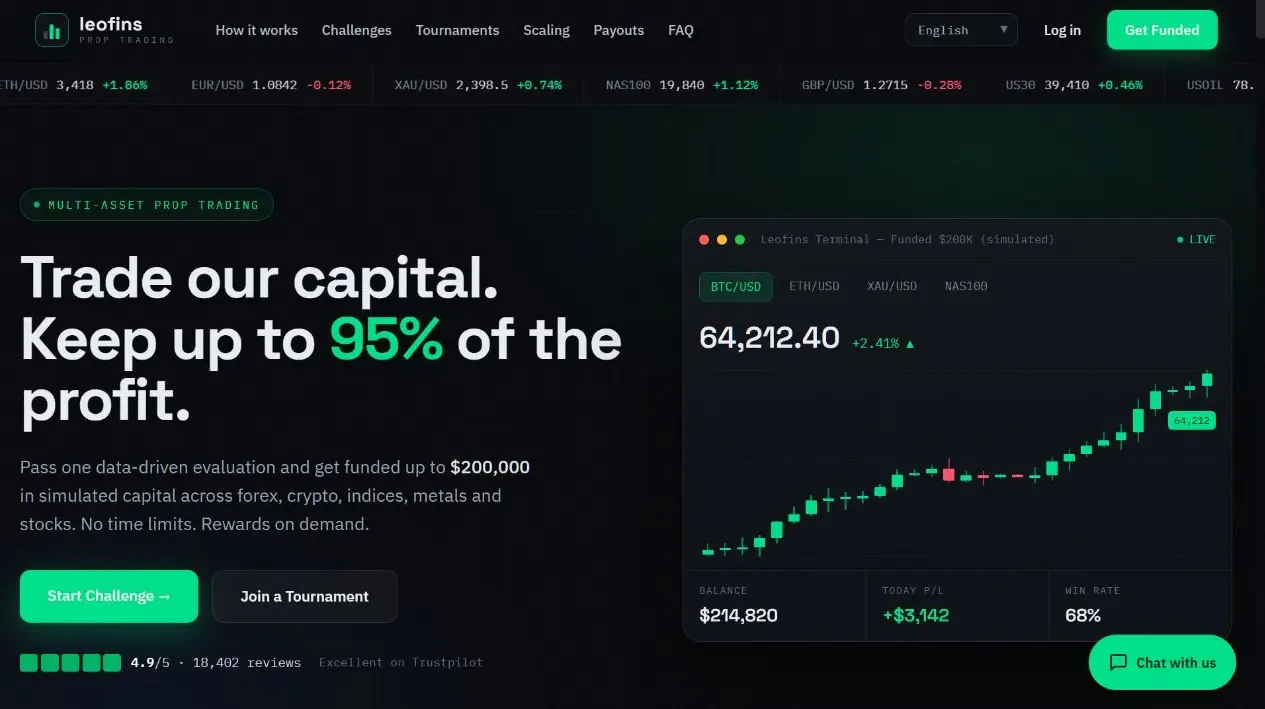 Leofins permits overnight and weekend holding on its CFD programs, but its rules place a specific limit on planned risk carried through the weekend. For evaluation-derived funded accounts, aggregate planned weekend risk may not exceed 1% of the initial account size. The Direct program has a lower stated limit of 0.5%.
This distinction is important: the rule is not simply permission to leave any number of positions open. Traders need to consider their combined exposure rather than assessing each position in isolation.
How to interpret the risk cap
Suppose a trader has a $50,000 evaluation-derived funded account. A 1% weekend planned-risk limit corresponds to $500 of planned risk across the positions carried into the weekend. The calculation must follow the firm’s current definitions and rules for aggregating related positions and exposure.
A trader who holds three positions with individual stop-loss risks of $250 each could therefore exceed the limit, even though no single position risks more than 1% of the account. Correlated trades can also concentrate exposure, so simply counting positions is not enough.
Leofins https://leofins.com/ also states that normal swap rates apply to CFD positions held overnight. Traders should therefore account for financing costs as well as the weekend risk cap. The firm’s separate futures offering may have different conditions, so CFD rules should not be assumed to apply to futures accounts.
Best suited to: traders who want overnight and weekend flexibility but are comfortable managing a clearly defined aggregate exposure limit.
6. Blueberry Funded: Most Accounts Permit Weekends, With One Key Exception
Blueberry Funded permits overnight holding across its account types. Weekend holding is also permitted on most accounts, but its Flex 1-Step program is an important exception.
On Flex 1-Step, positions must be closed before the weekend. The firm’s guidance warns that positions left open may be closed automatically. The restriction applies across the relevant stages, so traders should not assume that qualifying for the funded stage removes it.
Why account selection matters
Two accounts from the same firm may offer different holding conditions. If a strategy requires holding through Saturday and Sunday, selecting Flex 1-Step without checking its restrictions could make the account unsuitable regardless of whether the strategy is profitable.
The firm also highlights the risks associated with weekend gaps and reduced liquidity. A stop-loss order may not guarantee an exit at the requested price if the market reopens beyond that level.
Best suited to: traders who want weekend flexibility and can select a program that permits it. Traders considering Flex 1-Step should plan to close positions before the weekend.
7. Topstep: An Intraday Futures Model With Mandatory Closing Times
Topstep differs from the other firms in this comparison because it focuses on futures trading rather than forex and CFD programs. Its rules require positions to be closed by 3:10 p.m. Central Time on each trading day, with trading resuming at 5:00 p.m. Central Time. Swing trading and holding positions from one session to the next are not permitted.
The firm states that open positions and pending orders begin to be cancelled automatically at the required closing time. Risk management may begin flattening positions before the deadline, but traders remain responsible for being flat on time.
What this means for strategy design
A futures strategy that depends on capturing overnight price movement or holding a position until Monday would not fit Topstep’s standard day-trading structure. Traders need to design entries and exits around the required closing time, including the earlier close that may apply to certain products.
This does not automatically make the program unsuitable. An intraday strategy may benefit from having a clearly defined trading session. The problem arises when a trader buys a challenge whose holding restrictions conflict with the strategy’s basic assumptions.
Best suited to: intraday futures traders who close their positions each session and do not require overnight or weekend exposure.
What Happens When a Market Reopens After the Weekend?
Even when a firm allows weekend holding, the market itself can create risks that are difficult to manage.
Price gaps
Markets may reopen at a substantially different price from Friday’s close. This can happen after economic announcements, geopolitical developments, company news, or other events during the closure. A stop-loss order may execute at the next available price rather than the exact level requested.
Lower liquidity and wider spreads
Trading conditions can change around market reopening. Wider spreads and reduced liquidity may increase costs or make it harder to close a position at the expected price.
Financing costs
CFD positions can incur overnight swap or financing charges. Depending on the instrument and provider, a charge applied around the end of the week may be larger than a normal overnight adjustment.
Drawdown limits
An unrealized loss can count toward the account’s equity-based risk calculations. If a market gap pushes equity beyond the permitted loss threshold, a firm may treat the breach as valid even when the position was allowed to remain open.
For these reasons, permission to hold is not a guarantee that the position can be carried safely. It only establishes that holding the position is allowed under the program’s rules.
A Practical Checklist Before Buying a Challenge
Use these checks to determine whether a firm’s policy fits your trading approach.
- Check both stages. Read the evaluation and funded-account rules separately. Confirm whether the same permission applies after qualification.
- Find the exact cutoff time. If positions must be closed, determine the relevant server time or time zone and whether the deadline changes with daylight saving time.
- Read the account-specific exceptions. Swing accounts, one-step models, instant programs, and optional add-ons can have different conditions.
- Calculate aggregate risk. Where a firm sets a weekend risk cap, include all positions and related exposure according to the firm’s definitions.
- Review swaps and financing. Check the cost of holding each instrument, particularly commodities and positions held over triple-swap days.
- Understand automatic liquidation. Find out whether the firm closes positions automatically, when that happens, and how it treats the resulting trades.
- Plan for gaps. Do not assume that a stop-loss guarantees the exact exit price after a market closure.
- Save the current terms. Rules change. Keep a copy of the policy applicable to the account you purchase and recheck it before changing your trading style.
Frequently Asked Questions
Can I hold trades over the weekend with a prop firm?
Yes, but it depends on the provider and the account. FundedNext and The5ers publish policies permitting weekend holding, while FTMO restricts it on Standard funded accounts but permits it on Swing accounts. Other firms apply model-specific restrictions or risk caps.
Are overnight and weekend holding the same rule?
No. A firm may permit positions to remain open from one weekday to the next but require them to be closed before the weekend. Always check both conditions separately.
Can a prop firm allow weekend holding during evaluation but prohibit it after funding?
Yes. FundingPips is an example of a provider whose rules differ between evaluation and certain Master Account models. FTMO also distinguishes between evaluation conditions and Standard funded-account restrictions.
Does an allowed weekend trade count as a safe trade?
No. Permission to hold does not remove market-gap risk, slippage, financing charges, or drawdown limits. A position can be permitted under the firm’s rules and still lose more than expected when the market reopens.
Should swing traders choose a dedicated swing account?
A dedicated swing account can be useful when the provider restricts holding on its standard funded account. FTMO’s Swing account is one example. Before choosing it, compare the full terms, including leverage, permitted trading methods, and any other differences that may affect the strategy.
What happens if I forget to close a position before the deadline?
The result depends on the firm’s rules. Some providers automatically close positions; others may treat a violation as a breach. Do not assume that an automatic close is available or that it will protect the account from every consequence.
Match the Holding Policy to the Strategy
The most suitable prop firm is not necessarily the one with the fewest restrictions. It is the one whose rules match the way you trade.
FTMO can suit traders who choose the appropriate account type, while FundedNext and The5ers offer published policies that permit overnight and weekend holding. FundingPips requires careful attention to account stage and model. Leofins allows weekend holding within a defined risk cap, and Blueberry Funded makes weekend permission dependent on the selected account. Topstep is a better fit for traders whose futures strategies are designed to close within each session.
Before purchasing any challenge, read the exact rules for the account you intend to use. Confirm when positions must be closed, whether the policy changes after qualification, and how risk, financing costs, and market gaps affect your account. A strategy that fits those conditions is far more useful than one that only works when the rules are ignored.
Prices and conditions are current as of October 2026.
Risk disclaimer: Proprietary trading evaluations involve financial risk. Challenge fees may be lost if an evaluation is unsuccessful or program rules are breached. Simulated trading and funded-program results do not guarantee future performance or income. Review the current terms carefully and never spend money you cannot afford to lose.